
As I embark on a new project, I thought this week might be a good time to discuss research and world-building, which, for me at least, are intricately connected. This is especially true for the project I have just begun – the seven-part series I am temporarily calling The Cobalt Fist.
If you read my blog last week, you may remember that this series takes place during World War II, and I hope to weave it into real-world battles across the Pacific and Europe.
Considering this, getting the research and world-building right is critical. Lucky for me, watching World War II documentaries and reading nonfiction about the period are some of my favorite ways to pass the time, and world-building is my favorite part of the writing process.
For The Cobalt Fist, it is important to me that the main characters not only are aware of real-world events and participate in them (to a degree) but that the series begins with the attack on Pearl Harbor, ends with (or shortly after) the bombing of Hiroshima and Nagasaki, and highlights the exploits of lesser-known, real heroes of the war.
To achieve this, I need to know what year each book takes place, what events happened that year, how my characters can fit into those historical events without altering them to the point that the history of my world is irrevocably changed, and what more obscure heroics took place.
A great example of this is book one, which I hope will be emblematic of the entire series.
The book will open shortly after the attack on Pearl Harbor, with the main character doing what much of the United States was doing at the time – reeling and trying to decide what the next move should be. Without going into too many plot details, let’s just say he – a superhero in Boston with around ten years of adventures and crime fighting under his belt – joins a special branch of the Army meant to investigate and combat paranormal or otherwise unnatural efforts made by the enemy. I wanted to start with a bang, but the US was barely involved at this early stage of the war. But there was one operation (that is somewhat overlooked today) that happened in the weeks and months following the attack: the Doolittle Raid.
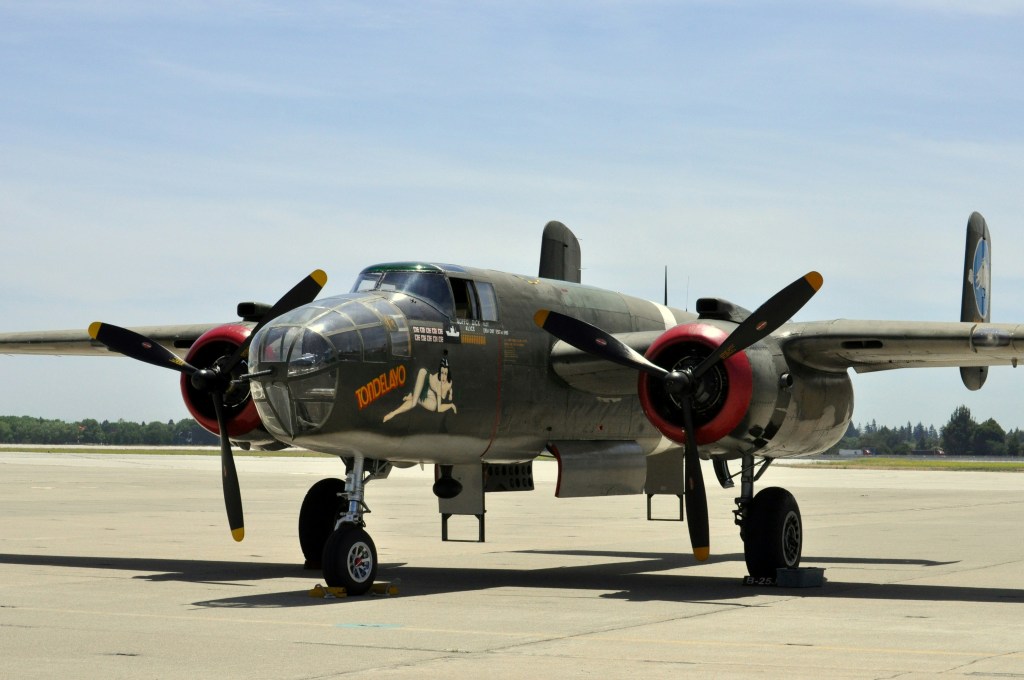
Depicted in the latter half of Pearl Harbor (2001), the raid utilized 16 B-25 Mitchell medium bombers to carry out a bombing run against Tokyo itself.
This operation is notable for two reasons in particular; the first is that B-25 Mitchell bombers are not and have never been designed to take off from the aircraft carriers that brought them within striking distance of Japan. The airmen at the controls had to train for weeks to pull off this feat and had to modify the bombers by removing as much weight as possible – including the tail guns, which were replaced with painted broomsticks to deter attack from behind. A prospect made all the more harrowing by the fact that they did not have a fighter escort; they were entirely on their own from the moment their wheels left the deck.
The second notable element of this operation was that it was a one-way mission. As soon as the bombers took off, the aircraft carriers turned away and headed for safe waters. The bombers didn’t have enough fuel to return to the carriers anyway. Instead, they made their approach over Tokyo, dropped their ordinance, and continued north towards China.
At least one bomber crashed into the sea, and another was captured by the Soviets, who, at this time, were not yet at war with Japan.
Doolittle thought the raid was a failure and was convinced he would be court-martialed upon returning to the US. However, as far as the US government and military were concerned, the raid was a resounding success. While the damage inflicted on the enemy was insignificant, it showed the rattled American people that they were not helpless and that the Japanese Empire was not as invulnerable as it might have seemed.
The Cobalt Fist cannot fly, doesn’t have super strength, nor can he fire lasers from his eyes. So, when hitching a ride with Doolittle’s Raiders, he will be rendered helpless and only be able to watch as real people make a significant mark on history.
 E.S. Raye
Leave a comment