
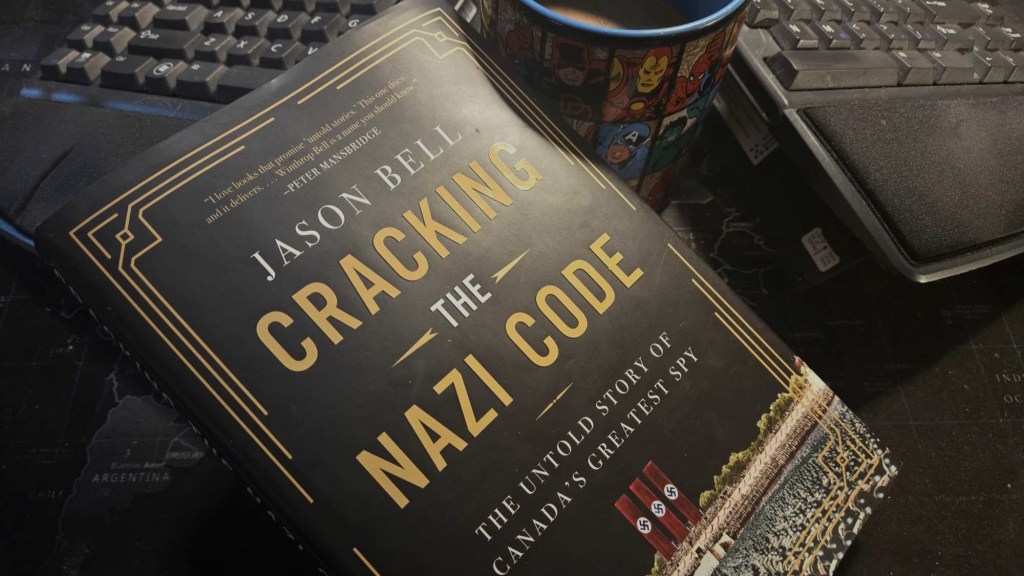
I really want to like nonfiction. I’ve started reading 3 nonfiction books over the last 6 months or so, and I have only finished one.
This one. Cracking the Nazi Code: The Untold Story of Canada’s Greatest Spy by Jason Bell.
And so, I feel it is my duty to take what little platform I have to share this incredible book and this incredible man. But that said, I haven’t written anything like a book report since the turn of the century, so please bear with me!
I’ll start by saying the story of Winthrop Bell was not the story I was expecting. If you’ve read my blog before you’ve probably picked up that I have a deep interest in World War II. When my wife gave me this (a random gift), neither of us had ever heard of it. We both assumed it would largely catalogue the adventures of Winthrop in Germany during the 1930s and ’40s.
That is not the case.
Instead, the vast majority of the narrative takes place between 1919 and 1921, immediately after the end of World War I, and decades before the outbreak of World War II.
However, despite not being what I expected, I found it utterly enthralling.
Without giving away too much, Winthrop was a philosophy student, finishing up his PhD in Germany when the Great War erupted. The first act of the book tells of his time right before hostilities, and then in confinement during the war. We learn of all the incredible contacts he has among the German elite, and his love for the country and his liberal-minded German friends. It is this love for the country and the good people who call it home that drives Winthrop through the remaining three quarters of the book.
Once the war is over, Winthrop is–through an improbable turn of events not disconnected from his and his family’s connections with powerful people in both Canada and the UK–recruited into the famous MI6. He is tasked with reporting the real-world situation on the ground in post-war Germany to the British government, and to the rest of the Allied world through anonymous articles written for Reuters.
And what he sees is a nation on the brink. Civil war, famine, extremism, and a budding Nazi party years before they called themselves that or had even heard of Adolf Hitler.
Not only is this story filled to the brim with historical inflection points where a different decision or outcome would have changed the very face of Europe and the world, it’s filled with Winthrop’s actual feelings about it. And that is the very reason I think I was able to inhale this nonfiction; thanks to Winthrop’s detailed diaries, we get a window into not only the events, but the man rushing to stop an atrocity he sees coming a generation away.
If you enjoy World War II history, spycraft, of the frightening parallels that can be seen into today’s political discourse, I cannot recommend Cracking the Nazi Code more.
 E.S. Raye
Leave a comment