

If there’s one constant in all my rantings and ravings about what I watch, what I read, and what I write, it is my love for a good genre mashup. And if I had to choose a favorite from among these niche subgenres, a good space-western would rank very high.
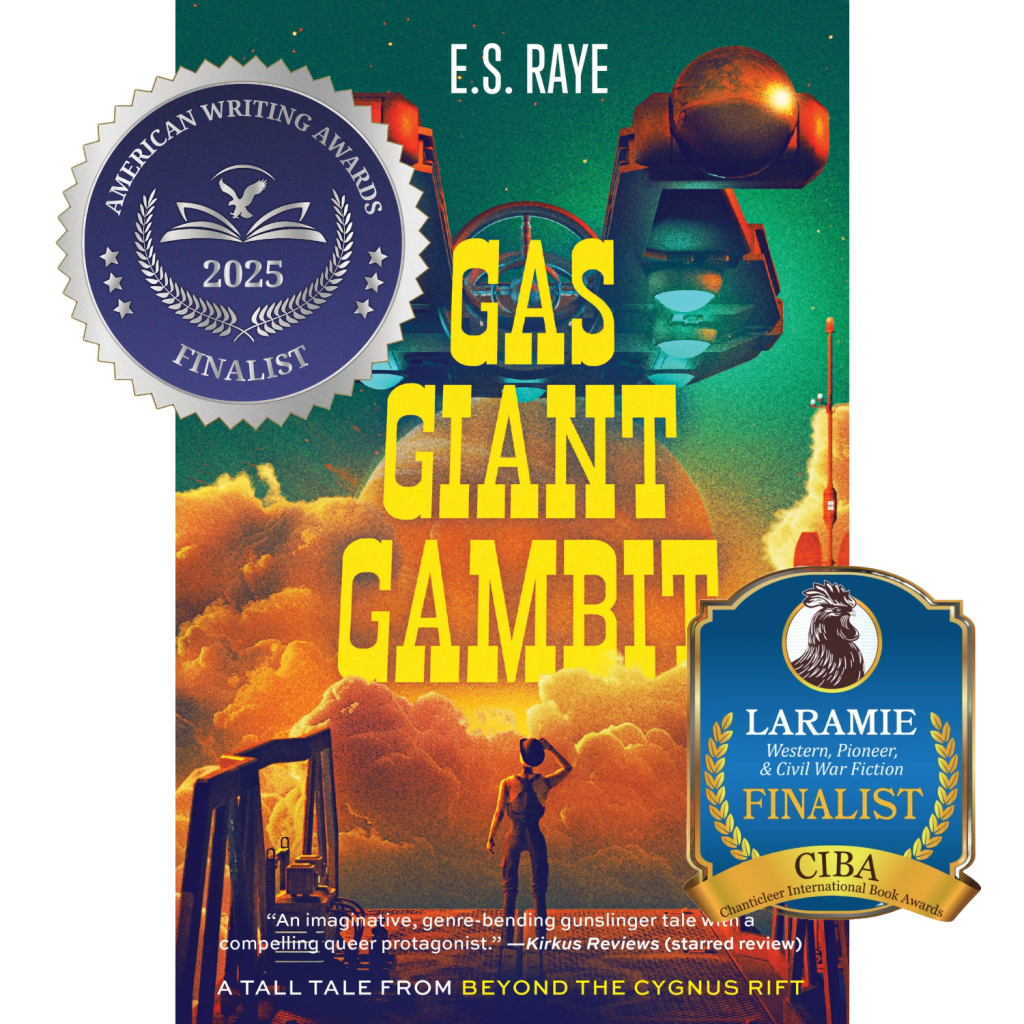
(It would have, to be the genre I picked for my debut novel, Gas Giant Gambit: A Tall Tale From Beyond the Cygnus Rift.)
And with Firefly back in the news recently, I think it’s a good time to give a little refresher on the spectrum between sci-fi and western.
What’s a Space-Western?
Exactly what it sounds like: a western in space!
There are a lot of variations on the theme, but usually, space-westerns feature the idea that the huge distances between stars have created barriers and hardships not unlike those faced by American settlers as they moved westward in the 1800s. Just like back then, these obstacles force people to become independent, insular, and often violent. People on the frontier are subject to whatever (if any) authority has laid claim to the area–for better or worse.
You can expect tropes and cliches from both westerns and sci-fi, twisted one way or the other to fit the new mashup. Like a train heist in deep space, for example.
But, the genre is a spectrum, so here are a pair of examples from either end.
Firefly
Sometimes, the metaphor is taken to the extreme, with gunslingers, rebels, and space cowboys. Firefly is undoubtedly the most obvious and popular example of this.
In Firefly, the main characters live on the edge of civilization, where they, and most of those around them, suffer the hardships of an austerity imposed on them by a far away government; government bent on punishing these areas for their role in a rebellious uprising and civil war.
The main characters, especially Captain Mal Reynolds, put on the airs of morally grey characters, despite being truly good (if perhaps “unlawfully good”). They smuggle cows. They visit desert-y worlds lacking in modern technology. And yet, the show mixes tech constantly, the best example coming from the episode where they defend a brothel from the corrupt leader of the town. The climactic fight features modern rifles, futuristic lasers, horses, and a small hovercraft complete with mounted laser cannon. Both the science fiction and western elements are abundant.
Outland
Other times, the connections between science fiction and classic western are more subtle–but they’re there if you know what to look for. My favorite example of this style of space-western is the 1981 Sean Connery film Outland. Where Firefly is dusty towns, horses, and “big damn heroes,” Outland is far more understated in its western influences. You’d be forgiven for thinking the story existed in the same universe as the Alien franchise; it has a similar look and explores some of the same themes (namely, corporate greed).
But at its heart, it is a western: Sean Connery is a new sheriff in town. He discovers corruption coming at the expense of the common man (in this case, miners–also very western), and tries to put a stop to it. That’s when a series of bounty hunters are sent after him and he must decide to run, or stay and fight–and maybe clean up the town.
It’s so western it’s literally the plot of the Gary Cooper film High Noon, except it takes place on Jupiter’s moon Io instead of some one-horse frontier town.
Gas Giant Gambit
So, from Firefly to Outland, where does my novel Gas Giant Gambit fall?
Without putting too fine a point on it: GGG is firmly on the Firefly side of the spectrum. Indeed, perhaps even further to that end than even Firefly dares tread.
In Gas Giant Gambit, faster-than-light travel is possible and widespread, but still quite slow compared to the vast distances involved. What’s more, faster-than-light communication is not possible; messages only travel as fast as the ship carrying them.
I envisioned that distance as the perfect metaphor for the prairies and deserts of the American west. In fact, it takes just as long for my protagonist Gus to travel from the “Old Colonies” (Earth being the center of) to the location the story takes place, as it would a person on horseback to travel from the well established eastern states to, say, Arizona or New Mexico in the mid-1860s.
And she tries to outrun her problems in much the same way, too.
Gas Giant Gambit drinks deep from the well of western tropes, with an old, tired marshal, a corrupt landowner, ranchers and miners looking for help, an exploited native population, outlaws, quick draw gunfights, gambling, and a protagonist with no name who blows into town (“Gus” is something of a nickname). Some tropes are played straight, while others are mercilessly subverted.
I set out to write a story you would expect to see John Wayne or Clint Eastwood starring in, and then set it on a fuel mining station floating in the clouds of a far away gas giant.
Of course, the science fiction tropes aren’t ignored either, with technology playing a central role in the story’s conflict. Not to mention the robot farmhand, the rancher with a bionic leg, and the semi-sentient spaceship that behaves like a loyal and trustworthy horse.
Don’t get me wrong; I love Outland. It may be my favorite Sean Connery movie. But, for Gas Giant Gambit (and perhaps a few sequels), the lure of the wide open gaps between starts called for something a little more overt.
Space-Western
Space-westerns have seen something of a resurgence, lately. First, it was The Mandalorian and its upcoming movie, and now a revival of Firefly. It’s a good time to be a fan.
If you’re a fan, you should check out Gas Giant Gambit. Reviews have compared to both Firefly and Mando!

 E.S. Raye
Leave a reply to My Top 5 Sci-Fi Books – E.S. Raye Cancel reply